Tuesday, 24 July 2012

PSV Accessibility Regulations

There are a number of myths around the above, which I shall try to address by explaining the background. There are two main groups of legislation, one of which has applied since 1995 and the other of which applies in part right now.

The Disability Discrimination Act 1995 and its replacement the Equality Act 2010 make it unlawful to discriminate against people in respect of their disabilities in relation to employment, the provision of goods and services, education and transport. This applies right now. Examples of things that the public transport sector is obliged to do could be: providing left-hand accelerator pedals for staff, amending a "no dogs" rule to allow assistance dogs to travel, or stopping in between two bus stops to allow a disabled person to board/exit. These principles have applied for many years, and continue to apply.

We also have the PSV Accessibility Regulations 2000. This legislation encompasses:

Dimensions and requirement of wheelchair space
Ramp, ramp angles and Kneeling
Priority Seats
Route and Destination Displays


Note that this legislation only applies to buses/coaches used on scheduled services or local services (and excludes tours) and does NOT apply to contract hire.

Every vehicle needs to be covered by an accessibility certificate (either an individual one, or a 'type approval' one undertaken by the manufacturer). Vehicles can be submitted for wheelchair accessibility (schedule 1) or general accessibility (schedule 2 for buses or schedule 3 for coaches) or both - both will eventually be required.

After the following dates, it will be an offence for a vehicle to operate without an accessibility certificate or with any of the above items defective:

MIDIBUSES (7.5 tonnes or under) with at least 22 seats (smaller vehicles not covered):
Built sep 2000 or prior (or built in 2000 and in service by 30th Dec 2000) require schedule 1 and 2 from 1st Jan 2015.

Built Jan 2001 to Sep 2004 require schedule 2 from new and schedule 1 from 1st Jan 2015.

Built from Oct 2004 require schedule 1 and 2 from new.
3ft

SINGLE DECK BUSES (over 7.5 tonnes):
Built sep 2000 or prior (or built in 2000 and in service by 30th Dec 2000) require schedule 1 and 2 from 1st Jan 2016.

Built from Jan 2001 require schedule 1 and 2 from new.

DOUBLE DECK BUSES:
Built sep 2000 or prior (or built in 2000 and in service by 30th Dec 2000) require schedule 1 and 2 from 1st Jan 2017.

Built from Jan 2001 require schedule 1 and 2 from new.

COACHES (single or double deck):
Built sep 2000 or prior (or built in 2000 and in service by 30th Dec 2000) require schedule 1 and 2 from 1st Jan 2020.

Built Jan 2001 to Sep 2004 require schedule 2 from new and schedule 1 from 1st Jan 2020.

Built from Oct 2004 require schedule 1 and 2 from new.

The above only applies to scheduled service work, not private hire.

So, what happens if someone uses a bus without the relevant certificates (or if the DDA features are inoperative)? Well, both driver and operator could receive a fine of upto £2,500.

Rather than me going through the required features in detail, I will list them in brief, and urge everyone to read the source legislation, which is pretty detailed. We'll do schedules 2 and 3 first, as they apply to more vehicles right now.

GENERAL ACCESSIBILITY (schedules 2 or 3)
Its important to realise that buses/coaches with steps could qualify for sched 2 or 3, and this may help an operator comply (if for example a tender is vague about precisely what he needs to comply with) until the dates when both 1 and 2/3 become mandatory.

There needs to be a 'priority' floor area which is flat (not including entrance steps) and this area must contain at least four priority seats (as close as possible to the entrance, and complying with certain dimensions). At least one priority seat needs to have enough room for a guide-dog to sit under or next to the priority seat.

There are measurements for steps (both those going upstairs, and any entrance steps), and requirements that handrails and handholds are in contrasting colours (and meet certain required measurements).

Communication devices (or if you're old fashioned, bells) within reach of every person sat in a priority seat, and for the non-priority seats, at least at every third row.  They must be operable by the palm of the hand, and in a contrasting colour.  Once pressed, there needs to be a signal to the driver to stop (doesn't specify whether visual or audible), an audible signal in the passenger area, and a visual "bus stopping" indication in each passenger area (which remains illuminated until the door opens).

The bus needs to be able to kneel, and the button to do this needs to be labelled in the cab.

Route and Destination displays need to be at the front and side of the vehicle (at the side, between 1.2 and 2.5 metres from the ground), and a route number display at the rear of the vehicle.  The route number (at the front and rear) requires characters of at least 200mm height (by my calculation, 569 point) and the side route number 70mm (199 pt).  The front destination requires characters of 125mm (356pt) and the side destination 70mm.  There is no requirement to have electronic blinds, no requirement that printed blinds are dayglo, and no requirement for white background/black background, as long as they contrast, are illuminated, and not in capital letters only.


WHEELCHAIR ACCESSIBILITY (schedule 1)
For a vehicle with seatbelts, the wheelchair area needs to face forward, and there be restraints provided.  A bus without seatbelts may have a rear-facing wheelchair space, which doesn't need belts, only a backrest and a horizontal hand rail.

The vehicle must be fitted with at least one boarding lift, boarding ramp, or carry a portable ramp at all times.

Entrances are required to be at least 800mm wide, and gangways as far as the wheelchair space(s) 750mm wide.

A white-on-blue disabled sign is required on the exterior of the vehicle by the entrance door(s) that wheelchairs are to use, inside the vehicle by the exit door (that wheelchairs are to use) and by the wheelchair space(s).  The wheelchair space also needs to have instructions of how to use it, and how to use any restraints.

Communication devices - in addition to the requirements under 'general accessiblity' there also needs to be a bell adjacent to the wheelchair space itself, which gives a different visual and audible signal to the driver than the 'general' bell.

Lighting sufficient to illuminate the interior and exterior to allow a wheelchair user to board and alight in safety is required.

Exemptions

There are some exemptions of little use to our industry (section 19 permits, transport of prisoners, transport of sick people) but the main one I expect operators will avail themselves of is:
"a vehicle in respect of which twenty years have elapsed since the date of its first use on a road and which is not used to provide a local service or a scheduled service for more than 20 days in any calendar year."

Or to put it another way, when we get to 1st January 2016 when a single deck bus needs to comply, a single deck bus that is at least 20 years old (built in 1995 or prior) does not need to have either accessibility certificate as long as it is used to provide a local or scheduled service for 20 days or less.  This could be useful for spare buses.


Remember, on checking passes, drivers/staff are checking only two things:
-that the pass is genuine (and not a forgery/not been tampered with)
-and that it is being used by the person pictured on it.

It is NEVER our place to suggest that someone 'doesn't look disabled' or to ask the passenger why they need the pass. Eligibility verification is done by others. Equally, with the 'companion' passes, the role of the driver is confined to entering whether there is just the holder or whether they also have a companion with them (abuse/misuse of this will be gauged by the issuing authority).  If staff have a genuine concern, then the time of use can be noted and can be passed to your supervisors who can discuss with the body who issued the card.

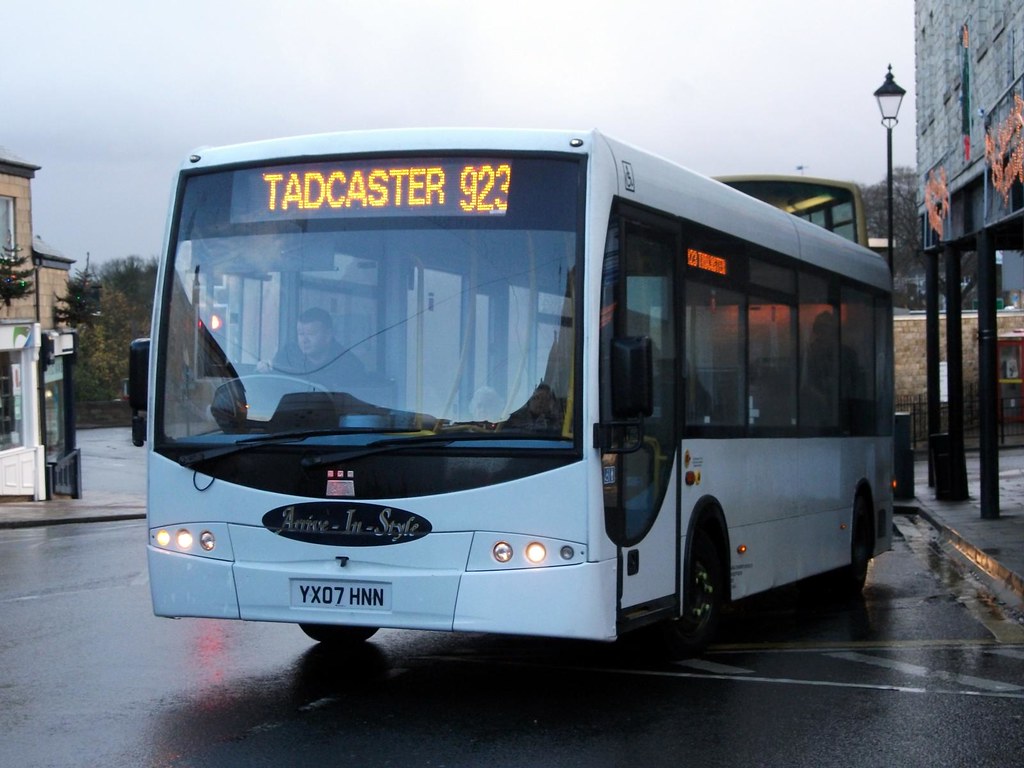
Finally, a quiz - two pictures, both showing how it shouldn't be done.  But apart from destination blinds, what else is wrong with these two vehicles? Picture of the white Plaxton Primo is provided by "Buses in West Yorkshire" on flickr.with thanks.


------------------

Thursday, 21 June 2012

Timetables at Stops


Anyone ever heard of the acronym KISS - keep it simple stupid.  Why can't West Yorkshire PTE and Travel South Yorkshire bear this is mind with their respective at-stop publicity.

We'll do Sheffield first.  I dropped a vehicle off at a garage in Darnall, and beforehand I checked their journey-planner to find out where I needed to go.  I was confronted with a cluster of four bus stops, with no common information at any of them, just the times for the buses that called (and their endpoints).  Do the buses for Fulwood and Millhouses go via the City Centre?  Or maybe via Meadowhall?  We don't know.  I followed my nose in the vague direction of Darnall railway station (an hourly service - totally inadequate) and came to the stop 5 minutes walk away that the frequent route 52 serves.  But one couldn't be expected to know that.

Leeds next, and two screenshots from the main stop on Leeds City Square for buses along Selby Road (Halton, Whitkirk, Colton, Garforth, Kippax).

Too many letters!  The First Leeds 19A timetable has notes A and E on one journey (this is an extra A to the A in 19A) to denote a route variation (to serve the Thorpe Park business park) - quite why two letters are needed to refer to the same service I do not know.  It would seem simpler to me for this journey (and the return in the evening) to be numbered 19B (or 18 or 20, which are vacant), and then to avoid the silly letters completely.  Then again, now that Transdev York serve Thorpe Park half-hourly during the daytime (seven days a week) perhaps First Leeds will either compete or give up?

The Arriva timetable is the biggest mess though.  We have a note (D on one route, E on the other) to advise that customers can board at four preceeding stops on certain services - I would suggest that this is of precious little relevance to people who have walked to this stop and are reading the information.

We then have the last service of the day given notes B and E (in addition to the D as above) of which B denotes terminating at Kippax War Memorial (which is fair enough) and E denotes runs via Kippax Cross Hills (all 163 and 166 buses do this, so no need to highlight it on the last service of the day).  Why does the last service of the day terminate at Kippax when the bus then runs dead to Castleford depot?  Surely it could run in service to the bridge over the River Aire just outside Castleford (Lock Lane) instead?

Anyway.... we have codes G H and sch for a journey that runs via Colton, via Garforth Academy, and schooldays only - this again would be simpler if this route could have another number.

The evening and Sunday route 166 journeys omit East Garforth station (heaven forbid that anyone from Kippax might want to connect with a train to York) as code F tells us - again, if these must observe a different route then surely a different number would be simplest?  Perhaps someone from Arriva could tell us why the residents of the Fairburn Drive estate (which is or was Europe's largest private housing estate so I understand) do not deserve an hourly evening and sunday service?

Numbers 164 and 165 are again vacant - and bizarrely 165 used to be used for one of the evening routes - so perhaps someone will see sense.

The real complaint over this timetable though is the lack of the Saturday evening service on routes 163 and 166, which does in fact run along the same lines of the other evenings.  WY Metro please get this corrected.  I still prefer the 'information' given in the West Yorkshire timetable to the mediocre effort made by SYPTE.

Sunday, 17 June 2012

Not the Wright Way to Reverse

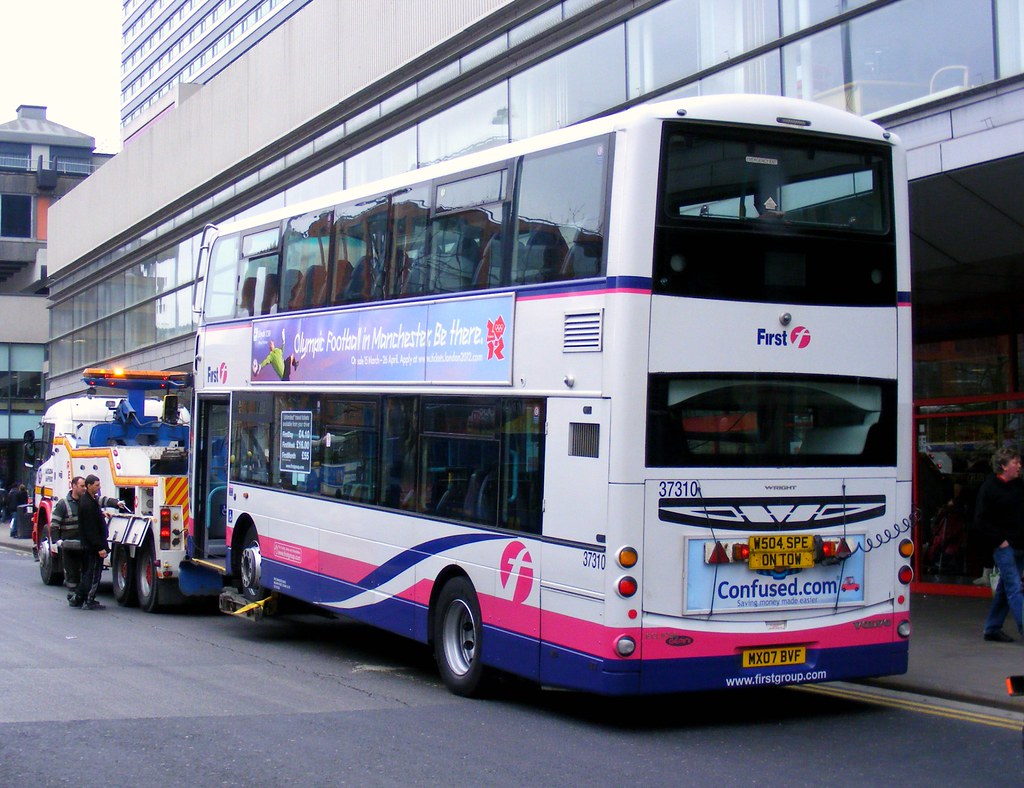
How many people have looked at one of the recent (past 5-ish years) products of WrightBus of Ballymena and thought that they have a defective reversing light.  I did, until I realised with horror what was actually going on.


Yes, this vehicle has only one reversing light (lower nearside, fairly standard I'd say).  The white lens at the lower offside contains a red-coated bulb, and is the rear foglight.

So why is this a problem?  Cars have had red or orange bulbs shining through clear lenses for many years.  The problem is that in many bus stations and bus garages across the country, you will see signs "reversing buses have priority" which is completely at odds with Highway Code Rule 202 which essentially obliges the reversing vehicle to give priority to any other vehicle or pedestrian.

Yet in these bus stations and bus garages across the country, bus drivers (following the instructions and policy they are obliged to) put a vehicle into reverse, release the handbrake and move backwards - all other buses being expected to be aware of this and give way to the reversing bus.

How does one know whether a bus is moving backwards?  Any reversing light being lit.  Conversely, a reverse light that isn't illuminated implies a vehicle that isn't reversing.  In some layouts and some light conditions, it may not even be possible to see the nearside reversing light anyway.  Also note that many drivers in a particular bus station may not be aware of this bizarre white lens foglight arrangement, as they may be on a different rota (or even from a different company) to the drivers that have been inducted on these Wright vehicles.

I call upon WrightBus to acknowledge with hindsight that these stylish white light covers are dangerous when used within the bus industry, and for them to prepare red lens covers and send to every vehicle with these rear clusters.  The alternative is to put a reversing light bulb and the red fog light bulb inside the same lens (which I am sure is possible) then every angle is covered.

I am of course aware that UK law doesn't infact require any working reversing lights at all - however when Health & Safety is paramount, I think that others need as much information as possible that 12 tonnes of bus is about to reverse into their path.

There is nothing at all wrong with making a mistake (car manufacturers do recalls all the time) - what matters is how this is dealt with.

The photograph I have linked to is from flickr user AndrewHA.

Thursday, 14 June 2012

Abandoned Bus Stop in Central Leeds

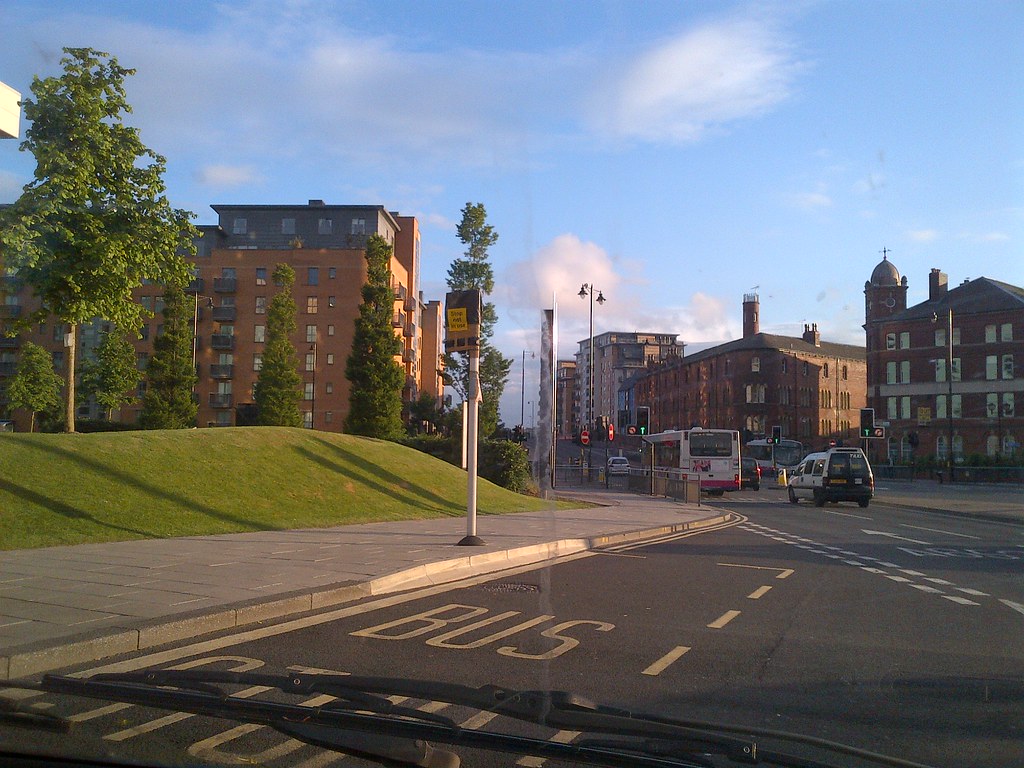
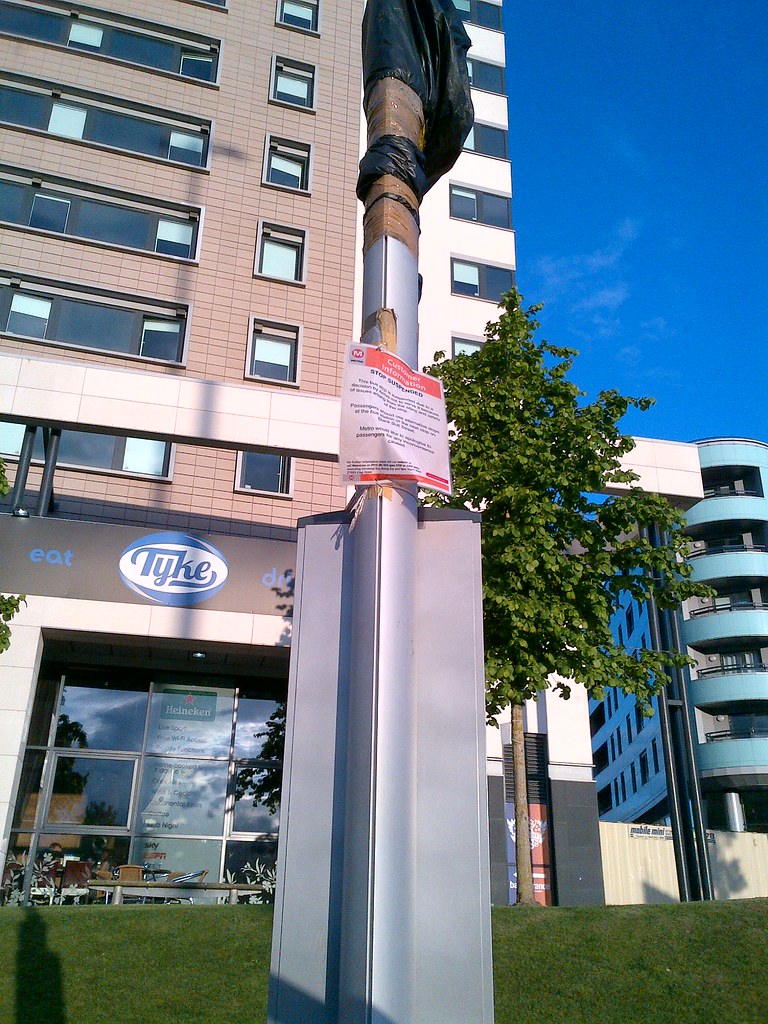
Hmm. Here is a picture of bus stop 45027893 Leeds eTap hotel. Nice smart stop, kassel kerb, right outside a budget hotel (which is very comfortable, double bed, bathroom, etc etc), as the live departures link will testify, a good selection of services provided by FirstGroup and Arriva. So why is there a black plastic bag over the flag?
  The wording states: STOP SUSPENDED This bus stop is suspended due to a decision by Arriva not to serve it because of issues arising from the (illegible) and safety of this stop. Passengers should use alternative stops at the bus station or the next stop on Black Bull Street. Metro would like to apologise to passengers for any inconvenience caused. What safety issues could be associated with driving off a layby bus stop?

West Yorkshire's Newest Bus Stop

Introducing bus stop 45014758, Guycroft in Otley A brand new bus stop, hasn't been one in this direction in this location before, to my knowledge.

A nice bus stop plate (which some bus stops in West Yorkshire do not have - hail & ride or "both sides of the road"), a timetable case (which again, quite a few bus stops in Yorkshire do not have) and a kassel kerb (which many bus stops in Yorkshire do not have).

What sort of service do we think this gets?  Every ten minutes?  Every half an hour?  Nope, four buses a day, all evening buses, of which one only goes to the next stop, along with two dalesbuses on Sundays.  Perhaps someone from TLC Travel who operate those four services could tell us whether the stop has ever been used?

Rumour has it that authorities across Yorkshire are looking for other virtually disused (and actually disused) bus stops at which they can install kassel kerbs.

In the meantime, I will report when this stop is fitted with a real-time information screen.